“The quality of your life is determined by the quality of the questions you ask.“
Dr John Demartini
Would you like me to show you how you can double the quality of your life? It isn’t that hard to do when you know the secret. So … here it is.
Most people only ask half the questions they need to.
Yep. That’s it.
That means that when trying to make a decision most people don’t have all the information they need. The result is poor quality decisions.
Take a quick example…
If you are considering a change in career path and you have an offer on the table from a prospective new employer the most common approach is to draw up a list of positives and negatives. The questions that sit behind that thinking often look like this:
- What would happen if I take the new job and leave my current role?
- What would happen if I don’t take the new job and stay in my current role?
That is a great way to start but it only gets you half the way there. You need to ask two more questions that at first look to be essentially the same questions but is not until you sit with them a while that you find that they are very different beasts indeed. Those questions are:
- What wouldn’t happen if I take the new job and leave my current role?
- What wouldn’t happen if I don’t take the new job and stay in my current role?
When you put it all together the questions look like this:

To apply the grid, first ask yourself “What is important to me?” Is it family, money, the opportunity to contribute, the opportunity for career advancement, flexibility, learning new skills? That will help you identify the things that you value.
Then sit down with the grid and write something in each of the four quadrants for each of the areas that are important to you:
- What wouldn’t happen in my career if I don’t take the new job and stay in my current role?
- What wouldn’t happen in my family life if I did take the new job and leave my current role?
- What would happen in my financial circumstances if I take the new job and leave my current role?
- What would happen around learning new skills if I don’t take the new job and stay in my current role?
There will be one combination that you will find will be the hardest question to answer for each of the things that you value. It may be a different question from value to value but stay with it.
Write what you can and leave it for a day or two. Then come back and try to add some more.
When you feel like you are done sit down and look over the entire list.
It will contain all the things that you might gain or lose (there might not be too many surprises there) and it will contain future opportunities to start something that will be lost and opportunities to stop something that will be gained.
All the things that wouldn’t happen if you didn’t.
Twice the questions, twice the quality.
***
If you enjoyed reading this or my other posts you can subscribe and receive them via email simply by putting your email address into the Email Subscription box just on the right of my blog home page. You will receive a confirmation email (which some systems will think is spam so keep an eye on your junk mail) that you need to acknowledge to complete the subscription process.
After you have subscribed, send this post on to your friends. Go on. You know at least one person who should read this post… seriously. Do it now.
expect a miracle (it is more than a simple card trick)
When you see him do it you are tempted to believe that Dr John is the reason that the magic happens. You think that it’s not so much what he’s doing with the cards that creates the magic, but that it’s because of who he is and the way he does it. And you would be right.
But you would also be wrong.
It is because of Dr John that so much of it happens – but you don’t have to be him to do it. He doesn’t ask that you give it a go or tell you that you should try it. In fact most of his power comes from the fact that he expects nothing from you at all.
It is what he expects for you that holds the key.
He will tell you (if you ask) that he has done it over 50,000 times – but don’t start thinking that it is difficult to do and that you have to practice it over and over and over to get the same result he does. You don’t. It is so easy to learn that there isn’t really anything much to teach. Just watch Dr John do it a couple of times and before you know it you will be able to do it yourself.
I know that to be true because I did it and got the same response when I wasn’t even expecting a result (and that dear reader might just be the key to it all!).
We were fixing up the bill at the end of a recent catch-up at a local Italian cafe. The waiter serving behind the counter handed Dr John back his validated parking ticket and apologised for the delay as they changed the paper in the EFTPOS terminal. Dr John thanked him and reached into his wallet. Leaning over the counter he said “Here, this is for you.” and he gave the waiter this card:

The waiter looked at the front. Then he turned it over (as everyone who receives one does) to find (as everyone who receives one does) that there is nothing on the back. No name. No phone number. No website. Nothing.
Then (as everyone who receives one does) he looked at Dr John with a sort of confused smile. Every part of Dr John smiled back as he said “It’s for you. Expect a miracle and I know that you will find one.”
Magic.
Twenty minutes later I am back in my office and a colleague notices the copy of Dr John’s book on my desk with one of his magic cards sticking out in anticipation of being used as a book mark. I explain to her that he is a friend and we have just caught up over lunch. I say “Here, let me give you one of his cards…”
She looks at the front. Then she turns it over (as everyone who receives one does) to find (as everyone who receives one does) that there is nothing on the back. No name. No phone number. No website. Nothing.
Then (as everyone who receives one does) she looks at me with a sort of confused smile and says “This isn’t a business card?”.
“No” I say, “It’s for you. Expect a miracle.”
And then it happened.
Like the waiter, there was a visible change in her that went beyond just the physical. It seemed like her whole being let out a huge sigh of relief and relaxed just for a moment. The waiter had responded in much the same way before he caught his breath and reached over the counter to shake Dr John’s hand and thank him for his gift. My colleague thanked me and smiled. She told me that she was facing a number of important decisions at the moment and that a miracle is just what she needs.
Now maybe she will get the miracle she is looking for and maybe she won’t. As Dr John will tell you, what is important is not having an expectation that a particular miracle will occur, but rather holding a sense of positive expectancy that miracles can be found just about anywhere you look.
And he is right.
The miraculous can be found in the most normal of situations if only you have eyes to see it.
And that is what I want to leave with you this holiday season. The expectancy of something miraculous happening in your life. (If you think you might need to be reminded you can visit Dr John’s website ExpectaMiracle.com and download a file that will allow you to create your own Expect a Miracle cards to keep nearby.)
Expect a miracle and I know that you will find one.
***
Dr John Hinwood is an international speaker, facilitator, mentor and chiropractic consultant based in Brisbane. John is a well-known author of numerous books on practice management and his latest book is an international best seller, You Can Expect a Miracle … The Book to Change Your Life. He has had papers published in academic journals and was once Captain/Coach of the Danish National Rugby Team! You can find details on when Dr John will be bringing his Expect a Miracle School to a venue near you by visiting his website.
If you enjoyed reading this or my other posts you can subscribe and receive them via email simply by putting your email address into the Email Subscription box just on the right of my blog home page. You will receive a confirmation email (which some systems will think is spam so keep an eye on your junk mail) that you need to acknowledge to complete the subscription process.
After you have subscribed, send this post on to your friends. Go on. You know at least one person who should read this post… seriously. Do it now.
Welcome to the organisation … Now how can I help you to leave us?
Do you find your current role satisfying? Are you committed to staying with your current employer? If you answered yes to both questions then you are officially in a minority…
Are you a manager who knows that your staff are the most important part of your business – even more important than the clients? Do you invest heavily in their training and development? If you answered yes to both questions then it seems you are also in a minority…
I have been talking with a lot of people whose business it is to help organisations get the most out of their people. Speakers, trainers and facilitators who have all been telling me that despite all the positive talk organisations are just not investing in their most important resource at the moment. The most common reason seems to be they don’t have the time – people are too stressed, too busy trying to do their day job to spend a day in training. Even if that training is about being more resilient and more effective in the workplace!
 A survey taken in September this year* has found that a majority of people don’t like their jobs and are either seriously considering leaving their organisation or will not commit to staying. Nearly half of senior managers are seriously considering leaving their organisation – not changing roles but leaving. The numbers at the bottom are no better – half of the employees aged between 25 and 34 are also seriously considering leaving.
On top of all of this one fifth of all workers are apathetic and would not commit to staying or leaving.
That means the next time you are in a meeting chances are two-thirds of the people in that room either are looking for opportunities elsewhere or are just at the meeting to pass the time because showing up takes less effort than looking for something else.
Any way you slice it that cannot be good for an organisation.
Which begs the question …Why?
Lack of training opportunities and career development support were two of the key factors. Being able to see how their work contributes to achieving the organisation’s overall goals is also important. This is particularly so for 25-34 yr olds who place a higher importance on satisfaction with the type of work they do than any other group and at the same time they are the least satisfied with the type of work they do and are the most likely to leave. (This is the same group who are the most likely to promote their organisation as a good place to work and are most willing to go beyond the requirements of their job to help their organisation succeed!)
That lines up pretty well with what I am hearing…
“You know, when I signed up I thought it would be a great place to work but now I find myself feeling increasingly uncomfortable with the way things are done around here.”
“I am happy enough doing what I do now but I don’t want to be doing it in five years time. I don’t want to become “management” and I just can’t see any other opportunities inside the company.”
Or something seemingly a little more problematic…
“I don’t want to do this anymore, I feel like it is time for a change. What I would love is a way to pay the bills while I study for my new career.”
The days of a person working their whole life for a single organisation are gone so I think the best thing you can do to get the most from your employees is to start from (before) day one and do everything you can to help them to leave.
- Be honest about your organisation’s values and goals. Let potential new hires talk one-on-one with the people they will be working with so they can ask how things are really done (and if you wouldn’t want every one of your current team doing that then you really have a some work to do!). If they don’t like the way you do things, chances are you are not going to like the way they want to do things.
- Be honest about opportunities to grow. There are only so many positions for higher paid help and if the people in those roles haven’t changed in the last few years then don’t bother talking about career paths. The flip side is you need to create a space where it is safe for people to tell you that is not what they want and for you to be comfortable with that.
- Be creative in finding ways to help people to leave your organisation in a few years time if that is what they want. Let them take their long service leave as a year of four-day weeks so that they can do volunteer work or study for a new career. I remember hearing of a local council in Canada who had a program that allowed you to put aside 20% of your pay so that every five years you could take a full year off on ‘full’ pay to do whatever you want. Where do I sign? (and why would I ever want to leave?). The value that their people bring back to the organisation in terms of different perspectives and new ideas must be supercharged by the energy they have gained by having a year to do what ever they want.
- Be supportive about a move to a competitor to take on a position with new responsibilities. Chances are that same person will be looking for a new role in a few years and your organisation might benefit from the experience that they gain.
The pay-off might just be employees who are more engaged and committed to your organisation. You would be able to plan more efficiently for the times when people will leave and if you follow the Canadian example you will have opportunities opening up each year for people to try new roles for twelve months.
To me that means that your employees will be happier and that equals happier clients and a happier bottom line.
I don’t think it matters what your organisation makes, what service your people provide or what resource it is that you extract from the earth and sell – if you don’t start doing something differently with your most important resource you are going to find yourself in trouble. And I don’t mean that you are going to be sitting in a meeting room where two-thirds of the people in the room are thinking about being somewhere else – you are going to show up for that meeting one day and end up sitting there wondering where the other two-thirds of your team have gone.
* Mercer – What’s Working TM survey – September 2011 and the Australian survey summary “Inside Employees’ Minds”
***
If you enjoyed reading this or my other posts you can subscribe and receive them via email simply by putting your email address into the Email Subscription box just on the right of my blog home page. You will receive a confirmation email (which some systems will think is spam so keep an eye on your junk mail) that you need to acknowledge to complete the subscription process.
After you have subscribed, send this post on to your friends. Go on. You know at least one person who should read this post… seriously. Do it now.
seeing what I want to be when I grow up
The future is not a result of choices among alternative paths offered by the present, but a place that is created–created first in the mind and will, created next in activity. The future is not some place we are going to, but one we are creating. The paths are not to be found, but made, and the activity of making them, changes both the maker and the destination. – John Schaar
Do you remember the day you graduated from Primary School? The sadness of leaving what were then effectively life long friends? The uncertainty around what High School would hold? A sense that a big step was being taken into the wider world towards being a grown-up?
Or maybe that is just how I want to remember it.
My daughter graduated from primary school this week so my memories of that event are much clearer! The ceremony that the school put together with the kids was wonderful and moved many to tears – parents, grandparents and kids alike. There was a lot of remembering of the events of the past eight years. Happy times, sad times, challenging times. Rewarding times.
There were also some words spoken about what lies before the graduating class. In the short-term it is High School. Beyond that, well who can say …
The promise of a future full of opportunity was held out to every child. The gratitude that that should be the case was shared by every parent.
 After the formal part of the evening there was a small celebration in the school hall. Every student had prepared an A3 poster to represent how they see the journey they have taken up to this point in their lives (I wonder what mine would look like if I was asked to do one today? I wonder what yours would look like?)
Everything about those posters told you something about the person who put it together. The pictures were worth far more than a mere thousand words. Some were neat and clean and carefully laid out. Others had a more chaotic feel. Stars and sparkle. Colour and collage. Short words and long paragraphs. Each one unique. Each one an expression of how they see their lives.
The one thing they had in common though was the open questions about their future. What would next year bring? A new school and new friends for sure. Beyond that, well who can say…
There was a cake, the unveiling of a plaque and some closing words and then a surprise – a couple of the parents had put together a simple presentation. One slide for each child in which they had photoshopped their face into an image that represented what the kids had said they wanted to be when they grow up.
It was a powerful experience for the parents. Seeing their child as a police officer, event planner, geologist, nurse, zoologist, artist or environmental engineer. Seeing a small piece of a possible future right now.
A possible future. Not impossible. And now seemingly a lot closer than it had been only moments before.
I have talked a little in this blog about how the images we form in our mind can influence what happens in the world. About the power of getting a clear picture of what we want and focusing on taking steps to create it. I have never seen that concept put into action so simply and so well.
What a powerful image to leave the graduating class with. To show them the future they dream of as if it has already manifest, created now in mind and will, and all they have to do is put one foot in front of another to take themselves there. What a wonderful gift.
So what do you want to be when you grow up?
It is a bit early for a new year resolution post but maybe it is not too late to create an image of who you want to be and share it with your friends and family. Maybe you will hear what many children were blessed to hear that night – I can just see you doing that in a couple of years! – and you will have taken your next big step into the wider world towards who you want to be. Even if, like me, you aren’t in a particular hurry to grow up!
***
If you enjoyed reading this or my other posts you can subscribe and receive them via email simply by putting your email address into the Email Subscription box just on the right of my blog home page. You will receive a confirmation email (which some systems will think is spam so keep an eye on your junk mail) that you need to acknowledge to complete the subscription process.
After you have subscribed, send this post on to your friends. Go on. You know at least one person who should read this post… seriously. Do it now.
if only …
Not a lot of words from me this week.
Funny how we get accustomed to doing something in a particular way. When I started this blog I had real trouble keeping my word count down. For the last week I have struggled with writing in a different, longer format that meant I had to write ten times as many words. If only it was as easy as writing ten blog posts and sticking them all together. The result wasn’t pretty – not what I was planning but fingers crossed it will do the job.
In the middle of that struggle I came across this TED video of Sarah Kay (Courtesy of Seth Godin and the friendly folk at the Domino Project). It reminded me of the power of words, the power of story and the importance of following your heart. Everything else will follow.
If only I could write with the lilting grace and measured cadence that Sarah Kay speaks. I don’t have a hoodie – but yeah, I really felt that.
I hope you do to (make sure you hear both poems – one at the beginning and one at the end).
the best way to avoid a punch …
Ever had one of those days at work when anything that could go wrong did go wrong? 
I know someone who has had one of those weeks and they are the first to admit they didn’t handle it well.
Their team had gotten so close. They were almost across the line when the wheels started to fall off. First one and then another piece of the project they had spent months putting together seemed to disappear.
Listening to them tell their story you would think they had done it all pretty well – working to understand other people’s concerns and issues and looking for win-win opportunities. In fact I think their team had found a solution to one particular problem that fell into the category of the being a whole lot greater than the sum of the parts. They were actively engaging and were sharing information. They knew that they were trying to negotiate organisational change – a new approach – so they weren’t expecting it to be easy.
But when it all started falling apart they started to act to protect what was left. As more fell away they fought harder to protect what remained – trying everything they could think of to gain some control over the situation. Nothing they did seemed to do any good.
That was where I think they made their mistake.
William Ury in his book Getting Past No says that in situations like that the first thing you should do is “go to the balcony”. Going to the balcony is a metaphor he uses to describe the emotional disconnect you should have instead of reacting to the conflict that arises in any negotiation. You can see Ury talk about it during a recent TED talk here:
In their book The Randori Principles, David Baum and Jim Hassinger have similar advice for when you start feeling like you are losing control. They call it “getting off the mat”. You walk away.
But that does not mean that you give up.
It means that you disengage while still remaining completely present. It means ending a conversation if the other person is disrespectful or not willing to collaborate. It means waiting until the other parties involved are ready. Sometimes it means that it is time to let go of what you have worked hard to create.
It seems counter-intuitive but if you continue to grab on to things to try to hold them in place you will become stuck and unable to move. Worse you give somebody else the power to use the thing you are holding on to to move you to places you might not want to go. If you let yourself become focused on the fist that is heading your way you narrow down your awareness and increase the chance that you are going to get hit.
A better course of action is to widen your focus and try to take in the big picture. Let go of any fixed positions and, if need be, purposefully decide to stay true to your values and step off the mat for a while. You can always step back on again.
It is the same advice that Mr Miyagi offered all those years ago in the original Karate Kid movie.
The best way to avoid a punch … is to no be there.
***
If you enjoyed reading this or my other posts you can subscribe and receive them via email simply by putting your email address into the Email Subscription box just on the right of my blog home page. You will receive a confirmation email (which some systems will think is spam so keep an eye on your junk mail) that you need to acknowledge to complete the subscription process.
After you have subscribed, send this post on to your friends. Go on. You know at least one person who should read this post… seriously. Do it now.
it hurts when you ignore me

ostracism |ˈästrəˌsizəm|
noun
1 exclusion from a society or group: the family suffered social ostracism.
2 (in ancient Greece) temporary banishment from a city by popular vote.
I gave a presentation recently to the Australian Tax office titled “Serious Play” that explored what games might have to offer today’s workplace. In it I put forward the view that what is missing in much of what passes for ethics training today is the opportunity to explore new behaviours in a space where the cost of failure doesn’t prevent the exploration.
It is not as easy as that though. The cost of failure has to be high enough so that it drives us to exhibit behaviours that we can reflect on later. In the presentation I put it this way:
If you don’t have a stake in the game …
then you have nothing to lose and
nothing to gain and
no motivation to learn!
You see I have been spending a lot of time trying to get to the bottom of why the Samurai Game ® offers such an intense and powerful experience to participants. At the simplest level it could be described as a group of people getting together to pretend to be Samurai. Instead of fighting to the death with swords they engage in more simple (and safer) battles like rock-paper-scissors.
But of course there is more to it than that (you will have to take part to find out just how much more!).
We invite you to participate in accordance with a set of values – honesty, integrity, courage, respect, honour. Easy enough to do in a game surely? You can be completely honest for an hour or two can’t you? I mean it not as if anybody’s life depends on it…
If you break the rules (or lose at a simple game like rock-paper-scissors) the result is effectively that you get to sit out of the game.
So what?
Then why is it that I have never seen a game where most of the participants don’t … well … bend the rules? The answer I think is wrapped up in the concept of ostracism.
In the January edition of Scientific American Mind, Professor Kip Williams published an article titled ‘The Pain of Exclusion’ that really got me thinking. In it he presents evidence that shows that we literally feel the pain of ostracism:
Even brief episodes of ostracism involving strangers or people we dislike activate the brain’s pain centers, incite sadness and anger, increase stress, lower self-esteem and rob us of a sense of control.
When we experience ostracism we experience pain.
I shared this story with a participant in a recent game and they recalled an episode when friends from their dorm had pretended they did not exist. For an hour or so they were ignored, spoken of as if they were not present, walked over.
The response it triggered was almost primal.
And that makes sense from an evolutionary perspective. To experience exclusion is to lose the protection of the tribe, to lose access to shelter, and potentially to food and water. Our response to ostracism is hard-wired within us to keep us alive.
So much so, says Kip Williams, that even if we know that a computer is programmed to ostracize us (or people we dislike do the same) we will still feel the pain and we will take action to avoid further pain.
And that is where most ethics training fails.
Case studies or on-line training tools only provide us with the motivation to answer the questions “correctly”. There is no pain!
The cost of failure is low and as a result so is the motivation to learn. The chance that it will change behaviour is even lower.
People need the chance to try – and to fail. The chance to move from “what would I do?” to “what did I do?”. It is only when the cost of failure is high enough to cause us to consider the clear bright line of a rule or prohibition as something more like a fuzzy grey spectrum that we have the opportunity to act and then reflect.
That is the opportunity I think the Samurai Game ® provides to each participant and one of the ways it does so is through the simple mechanism of causing you to feel excluded from the game. Even the threat of exclusion is enough.
The other members of your group (even the ones you dislike) get to continuing playing but you do not.
It hurts when you ignore me and that is enough it seems to get most people to bend the rules. That provides the opportunity to reflect on why it was that what we did do did not quite match up with what we said we would.
Simple. Elegant in design. Powerful beyond measure.
If your ethics training isn’t delivering the change in behaviour you are looking for then maybe it is time to cause a little pain?
***
If you enjoyed reading this or my other posts you can subscribe and receive them via email simply by putting your email address into the Email Subscription box just on the right of my blog home page. You will receive a confirmation email (which some systems will think is spam so keep an eye on your junk mail) that you need to acknowledge to complete the subscription process.
After you have subscribed, send this post on to your friends. Go on. You know at least one person who should read this post… seriously. Do it now.
I am a fish. You are the moon.
You don’t have to physically touch somebody to move them. That is something that Aikido has taught me.
Often their expectations around what you might do in future is enough to generate a response within them. And then they move.
When it does happen it can feel like a magical experience. It can look like it has been “set up” but it is not. All you need for it to happen is a connection between the people involved. But many people still doubt it when they see it.
Nobody ever questions the ability of musicians, actors or other types of storytellers to evoke strong responses in us. We can be moved to tears. Inspired to take action. We can experiences fits of laughter or fits of rage.
It is a physical response. It is visceral.
The words they say and the things that they do generate a response within us. While we may only experience them briefly (the four minutes and four seconds of Gotye’s Somebody that I used to know or the three minutes twenty-eight seconds of the West Wing’s Two Cathedrals speech) they touch us, they create expectations around what might be done and we are moved.
No matter what organisation you are involved in, be it a workplace, a school, a family or a community group, there are always people who are given that responsibility. We may never see them in person. Perhaps we will hear them on video. Perhaps we will read their words on paper. Perhaps we will see only the effect of the actions they take writ large on the faces of the people around us.
Based on that experience, our expectations around what they might do in the future is enough to generate a response within us. And then we move: we can be moved by them to cry tears of frustration or inspired by them to take positive action. We have a name for these people. They may be musicians, they may be actors (I think they have to be storytellers).
They are leaders.
And to borrow (or maybe mangle?) Rumi’s metaphor they are the moon and we are the fish. Their light fills the ocean in which we live. They may not be able to physically touch us but they cannot help but move us.
It is a huge responsibility and I am sure you won’t have to look very far to find recent examples of where our leaders have failed to bear the heavy weight.
But…
I am a fish. You are (also) the moon.
(If things fail to turn out the way you wanted them to maybe it is time to ask what expectations your words or actions are creating in the people around you? What is it that you are doing that is moving them?)
You cannot touch me, but your light (yes you dear reader!) fills the ocean where I live.
It is a huge responsibility that we all share. And one that should not be taken …. well, lightly.
***
If you enjoyed reading this or my other posts you can subscribe and receive them via email simply by putting your email address into the Email Subscription box just on the right of my blog home page. You will receive a confirmation email (which some systems will think is spam so keep an eye on your junk mail) that you need to acknowledge to complete the subscription process.
After you have subscribed, send this post on to your friends. Go on. You know at least one person who should read this post… seriously. Do it now.
I know you believe you understand what you thought I said,
but I hope you realise that what you think you heard me say is not what I meant.
On the plane back from Shanghai I watched a documentary about how our senses deceive us and how illusionists use our own senses against us. There is one particular effect where you can hear someone saying “ba” but if you see a mouth making a “fa” sound you will only hear “fa“. Even if you know what is going on you only hear “fa” because that is what your brain expects you to hear.
I thought that was interesting. Irrelevant, but interesting.
Do me a quick favour? Go back and read the title of my previous post. Just the title, then come back here.
Go on. Go here and read the title…
Now what did it say?
“my black belt in Aikido” ?
or
“my back belt in Aikido”?
I spend a fair bit of time trying to make sure that my posts communicate what I want them to communicate. I will admit to feeling a certain responsibility to be clear about when I want to be clear and when I deliberately do not. I know that I do not always get it right but I try.
I thought my last post was pretty clear. The pain I experience in my back has taught me a lot, including a lot about Aikido. I thought I had made that distinction until I talked to a couple of you who had read that post. But the context was one of Aikido and that seems to have set the mind to receive Aikido related information.
As a result they had never read the words “back belt” … only “black belt”. There is a difference. Only one letter but it makes a big difference.
What did you read? (Be honest and leave a comment on this post so I know one way or another.)
Either way it will make me think more carefully about the words I use when I try to communicate. It will prompt me to think about the context and the possibility for confusion or to accidentally rub people up the wrong way.
I hope it will remind me that the responsibility for being understood always sits with me and not with the person I want to receive my massage. That I will think twice before choosing “go” and “no” as my options to direct the diver of a vehicle.
I hope that you will not make the same mistake I did.
One litter can make all the difference.
***
If you enjoyed reading this or my other posts you can subscribe and receive them via email simply by putting your email address into the Email Subscription box just on the right of my blog home page. You will receive a confirmation email (which some systems will think is spam so keep an eye on your junk mail) that you need to acknowledge to complete the subscription process.
After you have subscribed, send this post on to your friends. Go on. You know at least one person who should read this post…
my back belt in Aikido
They say that it takes an average student about 10 years to get their Black Belt in Aikido.
They say once you have it you are finally ready to begin learning …
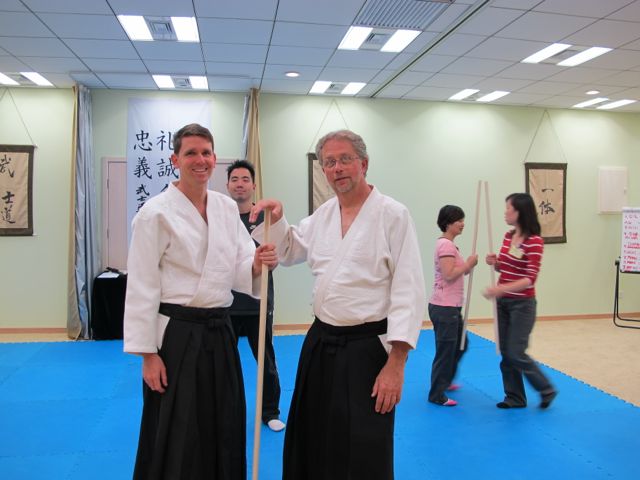 8 October, 2011. Shanghai.
I can’t remember the last time I put on my Hakama. I am not sure I remember how to put it on! I think it was months ago when I was in Malaysia with Lance. Then I said I would not roll. This weekend I have said I will. It should be OK. I have worked towards this for months now. I was careful during the flight over and I have stretched a couple of times a day for the last two days.
This is the second session of the workshop. We have the mats out and the room looks great. We bow in and Lance starts introducing some of the content for the day. I don’t remember the first technique but I do remember getting a whack on the nose.
It reminds me to be present. To be in the room.
The next attack is a simple one. But it requires me to roll out of it.
January 1, 2011. Brisbane.
Some people say that how you spend the first day of the year is a good indication of how the rest of the year is going to go. If they are right, then I am not happy.
I have a long-standing goal to get my Brown Belt in Aikido. I have had my Blue Belt for almost ten years now and around May 2009 I decided it was time to get back on the mat after a long time away.
I started out slow. Did some general exercise for a month or two to try to improve my fitness levels and then stepped cautiously back into the Dojo. I had forgotten many things including how to put on my Hakama.
I think I lasted about three weeks before my back went.
There was that horrible feeling when you know things just aren’t right, that in about an hour or two it is going to get worse and tomorrow morning is going to be real ugly.
My physiotherapist got me moving again and told me I really should listen to him this time and take up Pilates. Which I did.
For 14 months now I have been continually amazed at how disconnected I had become from my body. If you saw me running down the street you wouldn’t notice anything unusual – but during a Pilates class movements that should be easy to complete are not.
For some of them the right side of my body finds it easy enough to do ten repetitions but the left side of me struggles to do two. More disconcerting (and interesting) are the simple movements that I just cannot do. I understand what I am being asked to do but when I ask my body to do it … nothing happens.
Still, I know I have improved. I can now do many things that I couldn’t when I started, some of which are quite impressive. My core muscles are much more stable than they have ever been.
I felt confident I had a foundation that meant I could get back on the mat and restart the journey.
Until today. New Year’s Day 2011. For no reason I can put my finger on, today things just don’t feel right. Today of all days – the first day of the new year, a day of almost universal optimism. Nothing seems to be helping and I get the feeling that it is going to get worse before it gets better…
17 October, 2011. Brisbane
Looking back I wouldn’t say it was the most graceful Aikido display ever seen in China but I managed to get through a day on the mat without injury. I even managed a couple of rolls that didn’t look or feel half bad.
With the benefit of hindsight, it was clear that in 2009 I didn’t have the necessary foundation in place on which to build my renewed Aikido practise. My sense back in January that things were going to get worse was right on the money. I had minor flare ups two weeks before I was to be in Malaysia and then on June 4 this year I experienced pain like nothing I had ever experienced before.
But here I am half way through October and things are getting better. My back is not ‘fixed’ just “better”.
It took me almost 40 years of bad habits to create the problem so expecting to fix it with a couple of Pilates classes seems more than stupid now. I figure that another year or two of continuous attention should get me to somewhere near to normal.
Maybe.
They say that it takes an average student about 10 years to get their Black Belt in Aikido. They say once you have it you are finally ready to begin learning.
I don’t have a Black Belt in Aikido but I have recently awarded myself a Back Belt.
I have learned a lot during my time off the mat. About pain, about frustration and about the persistence that is required to get through the inevitable set backs. I discovered that there was much that I did not know about myself. About where the tension hides in my body. About the way that certain muscles tighten when I am under stress. About the way I have failed to make use of other muscles that have since faded through lack of use.
I learned that I had to do a lot of work before I could even start to learn those things.
I learned that I had to have a solid foundation in place before I could build.
What about you?
Is there some part of your life where you feel you are always failing? Could it be that you are trying to build something before you have put in the work to create a solid foundation?
***
I was in China to help Lance Giroux deliver his workshop “The Art of Practice and the Organisational Dojo” You should contact Lance and have him bring his unique offering into your organisation. I have been a part of this workshop in Australia, Malaysia and in China and everyone comes away from them raving about how brilliant they area. You can contact Lance via his website www.alliedronin.com
If you enjoyed reading this or my other posts you can subscribe and receive them via email simply by putting your email address into the Email Subscription box just on the right of my blog home page. You will receive a confirmation email (which some systems will think is spam so keep an eye on your junk mail) that you need to acknowledge to complete the subscription process.
After you have subscribed, send this post on to your friends. Go on. You know at least one person who should read this post…


 finding my own Way