be careful what you say… somebody might listen
I have written about our daughter’s mice before – there is something very “Hitchhiker’s Guide” about them. Before I came to realise that I might learn something from them I had developed a firm view about them. The first pair we had were OK – not my personal choice of pet, but I kept that view to myself.
When one developed a tumour that eventually resulted in a visit to the vet, I was supportive of a decision to find a replacement and did not voice any objections. While the odd bit of peace and quiet is nice, I don’t want to live alone and I don’t want the mouse to have to either.
I felt that I was understanding when not one but two mice came home because all the girls in my life felt like they should have a mouse to call their own. They had already settled in by the time I discovered they were there, so there wasn’t much point in saying anything.
When the newcomers picked up a mouse virus and one by one all three developed nasty coughs that saw them head off to the vet and not return, I thought we had experienced enough to move on. A moment’s silence marked their passing.
When new mice and a new cage (the virus responsible for the cough is apparently impossible to remove once it has taken up residence) appeared one afternoon it was time to give voice to my thoughts on the matter.
“These mice are a bloody waste of money. It has got to stop!”
That was quite a while ago now. Mother’s Day has been and gone. We still have mice – maybe even newer ones again. I don’t know to be honest and nobody listens to what I say anyway.
Or so I thought.
When I was cleaning up the other day I found a Mother’s Day gift from one of our daughters. Simple. Hand made. Inscribed with words that knocked the wind out of me in a way that only a revealed truth can…

People do listen to what I say. They listen very carefully and reflect on my particular choice of phrase in ways that I might not care to imagine. They tell other people what I say (even if only indirectly). It can change the way other people see the world.
The words I choose to use influences what they believe to be valuable and what they then might come to know as having no intrinsic worth.
It is a lesson I have been slow to learn.
giving them permission to fly, or at least to try…
A couple of times in recent weeks I have been presented with an opportunity to become more aware of how my preconceptions and judgments around what others are capable of can be all that is needed to prevent them from achieving wonderful things.
The first was when my eldest informed me that she was working on plans with a friend of hers. The plans were directed towards a single goal – flight. Now before you think these are the plans of some wildly unrealistic kids who hadn’t given the challenge some serious thought, let me tell you that the initial target was a modest one. “We aren’t trying to fly like a bird Dad, we just want to get a few centimetres off the ground to start with – just to lift off a bit.” Together they had developed a design for wings made from sticks, paper and duct tape (where would modern civilisation be without duct tape!).
We discussed some aspects of the design, I offered to cut some of our bamboo for her to use instead of sticks (bamboo is lighter and stronger) and I made her promise not to jump off anything without first getting clearance from air traffic control (me).
I wasn’t allowed to assist with construction nor was I allowed to witness the test run of the design. I am sorry to report that the design apparently did not deliver the hoped for ‘hover’ – something was mumbled about the bamboo not being strong enough. Doesn’t matter though. I am just glad that she was prepared to try, and that I caught myself before I said “but sweetheart, people can’t fly – other people have tried and failed so don’t waste your time.”
I am not always so quick to catch myself though…
The rehearsal period for a theatre production is never long enough. There is a lot of pressure on everyone to get it to the point where you have a show you can put on the stage. The lines are often first and outline the piece, the blocking (where people move/ sit/ stand/ fall on the stage and what they move to/ sit on/ stand near/ fall over) comes next and adds some space to each scene before adding in all the personal props (bags, hats, coats, books, drinks, pens, cake …) which helps to start colouring in between the lines.
Now I am no expert so this is all just my opinion, but I don’t think you can really give your actors permission to fly until you get all that other stuff sorted out. What tends to trip you up is the tendency (in both me and the actors) to want all of that perfect before stretching our wings.
I wouldn’t say I got tripped up during Hat Tricks but I certainly started to feel a bit of a stumble before I stopped myself and sat down with my cast. I needed to remind everyone, me included, that the theatre is a place where magic can happen.
What I had forgotten was that, as the director, part of my job was to give the cast permission to try. My job is to discuss the design they have in mind for their character, do what I can to help them execute their plans and to keep them safe.
Implicit in all of that is giving them permission to fail. Our seasons are fairly short – only nine shows. I would much rather that my cast deliver four ok performances, four performances that didn’t quite work and just one performance that left the audience in tears of laughter, rage or sorrow than have them deliver nine ‘safe’ performances.
So that is what I told my cast and I think it made all the difference. With seven performances under our belts people have laughed and loved some pieces, been confused and annoyed by others (cast included), found the behaviour of some characters so frustrating they didn’t enjoy some scenes and, yes, there have even been tears from those who have been touched by the emotion in other scenes (me included).
In reality, giving other people permission to try and permission to fail is the easy part. It is when we have the opportunity to give ourselves permission to fly that we hear a voice saying “… you can’t fly – other people have tried and failed so don’t waste your time.” Don’t listen to it.
I have more than enough duct tape for all our dreams.
what ever you do, don’t use a negative!
The reason that I haven’t written anything for a while is that life got a bit too hectic. Work, family and directing a production of Hat Tricks with the Sunnybank Theatre Group meant that I either didn’t have the time or I just didn’t have the energy to put anything down on paper.
They say that life is not a rehearsal and I for one am glad of it. The rehearsal process can be many things but when you are doing it at night and on the weekends it takes not only your time but a great deal of your energy. As the director it is your job to worry about everything – particularly when you are working in community theatre.
Before you say anything, I know I need to get better at asking for help, but this time around was my first full length production. So I ended up doing the set design, a lot of set construction and dressing, props, furniture sourcing and repair, coordinating with the wonderful milliners at MSIT who made our hats, getting a stage crew together, lighting cues set up, figuring out how to use the sound software, searching for music and the sound of a toilet flushing… all on top of the main business of helping the actors prepare their pieces!
The hats are a key part of the show so after one rehearsal when one of my cast came on without her hat I think it was understandable that my feedback would include “Please don’t forget the hat next time – it is kind of important!”
Now I have been blessed with a wonderful cast and crew who are very gentle and understanding of me so her response was to simply nod and then smile and say “I remember my hat each time I go on stage.”
For me it was a timely and generous reminder of the importance of avoiding the use of the negative. I know this stuff, I have taught it in my workshops – the brain isn’t very good at processing negatives like “don’t” when it is under pressure. We work in pictures so the command “Don’t put the knife in the toaster!” will automatically bring up an image in your mind of a knife in a toaster. If we are under pressure we respond to that image and hear the commanding tone and end up doing exactly what we have been told not to.

A negative image of a toaster.
I am not sure if you have ever stepped onto a stage as an actor in front of a hundred or so people you may or may not know, but I think it counts as a high pressure situation. So saying “Please don’t forget the hat next time – it is kind of important!” was likely to result in an actor walking on stage sans headwear!
Since then I have tried to stay aware of how often I use negatives in both my family life and in my work life. It is surprising how often I do use them and how easy it is to do:
“Please don’t forget to complete your timesheet/expense claim before the end of the month.”
“I know you are in a hurry but please don’t forget to pick up some milk and bread on the way home.”
“Peter, don’t let me forget to email that report to you!”
“Don’t forget to call your sister for her birthday!”
In the fast paced and busy lives we all lead that usually ends up with us getting reminder emails about our timesheets, apologising for missing a birthday and hearing our exasperated spouse or parent wonder aloud why they bother even asking.
Try it for yourself. Be aware of how often you make negative requests and see how often you and those around you do it. I think you will be surprised.
As for me, once I publish this I will be sure to remember to call my sister for her birthday. Happy Birthday Natalie!!
who receives the loudest applause?
I spent the day at the 2010 CSTD Queensland Dance Festival. Tap, ballet, song and dance. Groups of twenty-five and groups of two. Simple costumes through to groups with set that seemed Mary Poppins like to conceal far more children than it should. A wonderful day watching a generation give their best.
Some are clearly ‘more polished’ than others. Some seem ‘better funded’ than others. Some appear ‘more talented’ than others. Inevitably some receive louder applause than others.
It made me wonder why.
We don’t know their stories nor the stories of their parents and teachers. We don’t know how long they have been dancing or what particularly personal mountain they had to climb before they stepped on to the stage in front of us.
Once they have done what they came to do we judge their performance by the volume of our applause. We clap louder for our own kids because we know what it has taken to get them there. Then the adjudicator ranks them and somebody ‘wins’.
What I find inspiring about days like this is that the kids are willing to come back time and again and do their thing and then willingly submit to being judged by others who do not know their story.
It reminds me of an old man I saw walking slowly up a hill towards a suburban shopping centre that includes a pub. He was clearly having trouble and was unsteady on his feet. At 10:15 in the morning I can often to be quick to withhold my applause…
until I remind myself to consider what his story might be. Is he a recent widow on his first trip out alone? A cancer survivor, a diabetic who was told he might never walk again? A man struggling with an addiction without the support of family or friends?
Many people are willing to do their thing knowing they will be judged – and they just get on and do it. They know we will withhold our applause because we will judge them by some ‘objective’ standard, they know many will judge them to be ‘losers’ but they still step on the stage each day ready to dance. They are the ones who deserve the loudest applause.
Or perhaps we could just stop and give them a hand …
too young or too old?
So which is it?
Are you too young to do what you want to do or are you too old? It seems that the first is a choice that you make for yourself and the second is choice others try to make for you until you start to believe them.
I know that I am not too young to sail solo around the world. Jessica Watson has taught me that.
I know I am not too young to take on the role of Aikido Sensei – the younger guys who lead classes at my Dojo (and I remember them arriving for their first class) continue to show me that.
I am not too young to be pre-selected for a federal seat – 20-year-old Wyatt Roy has proved that. But I already knew that because a good friend of mine ran against Kevin Rudd.
I am not too young to speak at TED.
I am not too young to have a blog. (Although it took me a long time to get to the point where I believed that and now I am wondering if I am too old to have one. People younger than me are writing much better stuff than I am …)
A good friend of mine had a difficult day today. We talked about what had happened and the phrase “a grown man crying like a baby” came up. My observation was that while our bodies grow older I am not sure that we ever really “grow up”. I know that I often feel like a 16 yr old inside a 40 yr old body. (Apparently there is research that shows that actually keeps me young!)
Trouble is that we spend a lot of time planning what we are going to be “when we grow up” and not so much time being all that we can be right now.
My youngest sister told me recently that the only thing that someone can say that will stop her in her tracks is “Aren’t you a bit young to being doing that?”. We agreed that before too long those same people will be saying “Aren’t you a bit old to be doing that?” and that in both instances they are wrong.
So here is what I am telling myself from now on:
Don’t worry about being too young or too old. I am always the right age to try.
And so are you.
free range mouse
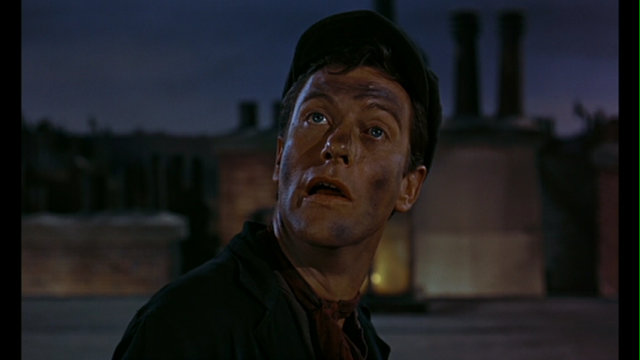
“They makes cages in all sizes and shapes, you know.
Bank-shaped, some of ’em, carpets and all.”
-Burt, from Mary Poppins
We have a mouse. A free range mouse. Her name is Star and I have to admit up front that I have soft spot for her.
She came from the pet shop – my wife chose her and brought her home. When she was young we found that the cage she lives in could not hold her. She was small and so could come and go as she pleased. Star would run around outside her cage and, at least initially, she would run back inside the cage when we approached. Over time we reached an agreement. She would stay in one place long enough for us to grab something nice from the kitchen and give it to her. Then she would run back behind the cage and enjoy whatever tidbit we had provided.
We were worried at first that she would decide to take her leave of the cage and of us but every morning we would find her back ‘safe’ inside.
Every weekend the kids would clean her cage and in the process take away the nest that she had spent her days creating. During the day she would run in the wheel, stop to eat or drink and, depending on what day it was, get to work rebuilding her nest. At night after the kids would go to bed she felt free to come out of the cage and explore the world.
And so the cycle continued.
On Sundays the cage would be cleaned and Star would get to work and spend days busy building a nest, running in the wheel, eating, sleeping. During the night she would leave the cage and charm treats out of us. Every morning we would find her back inside the cage we provided for her.
Then we started to notice that getting back into the cage didn’t seem to be so easy for Star. She was growing up and growing bigger – helped no doubt by our late night rewards.
Star hasn’t been out of the cage for a while now. She is older. She has food and water delivered a couple of times a week. From Sunday afternoon through to Wednesday she works at rebuilding her nest. She runs in her wheel and has other things that seem to occupy her time. I am not sure that she watches but she has a clear view of the TV as well, and for her it is VERY big screen TV!
Thinking about the zoos and animal parks I have visited I know that cages can come in all different shapes and sizes. There are different types of cages too, some that are so well designed you wonder whether the inhabitants are even aware of them.
But I think this is different. To me it seems that Star knows she is in a cage. She has chosen security over freedom and I don’t really understand why. I suppose it might be all that she has ever known – she has been in a cage of sorts since the day she was born. Perhaps I should be surprised that she ever came out of the cage at all? I mean why would she? She has a place to live, a huge TV, food and water, other people who create work for her to do each week and her own gym! Maybe she feels freedom seems to be a small price to pay for all of that?
I don’t know but I am glad that it is a decision I will never have to make …
***
If you enjoyed reading this or my other posts you can subscribe and receive them via email simply by putting your email address into the Email Subscription box just up on the right. You will receive a confirmation email (which some systems will think is spam so keep an eye on your junk mail) that you need to acknowledge to complete the subscription process.
looking backwards – Part 2 – first principles
It is funny the things you find yourself disagreeing with people about. I remember somebody saying that they had disagreed with their boss over the basic principle that underpinned the organisation. I suppose that is not so unusual until you discover the context in which the discussion took place.
It was during a company team building session attended by every employee in the company. Apparently their boss had put forward the view that the clients were the most important thing that the company had. Without them there was no money coming in and therefore no company. The alternate view, that the employees were the only thing that the company had, was brushed aside. The employees were there to serve the clients.
Call me crazy but I don’t think that is the right thing to say in front of all of your employees. Last I heard the company in question had a lot less employees and a lot less clients.
A quick Google search on the topic of “how we treat our employees” brings up phrases like “We know how important our people are for the success of the business and we value them as much as we value our clients.”. I happen to think that is worse than saying clients are more important because it is dishonest. The word ‘almost’ is clearly implied. It would be better if it said this (but I don’t think you would find these words on many Company websites!):
“We know how important our clients are for the success of the business and we value them as much as we value our people.”
The preamble from GUIDING PRINCIPLES AND OBJECTIVES IN EMPLOYEE RELATIONS addresses the issue this way:
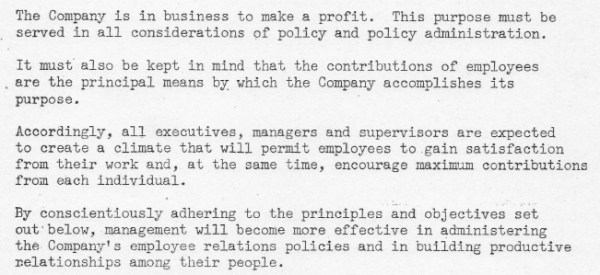
I like the honesty in the first paragraph and it is clear that even not-for-profit organisations have to make money to continue their work. I will note though that it doesn’t indicate the size of the profit that is required.
The second paragraph puts the first in perspective through the use of the word “principal” which means ‘first in order of importance’. The only way the Company can achieve its purpose is through the contributions of the employees. No employees no Company.
So far so good with me. I am happy to have those two paragraphs open the guiding principles for my organisation.
The great thing about the next paragraph is that it tells me how to go about realising those two principles. It is the responsibility of the executives, managers and supervisors to ‘create a climate’ – what a great phrase – they are expected to be proactive and create a climate in which employees can gain satisfaction from their work. In 1968 it was recognised that this is how you get maximum contribution from your employees – by making it the manager’s work to make sure the employees gain satisfaction from what they do.
Notice it doesn’t say managers should “ensure that employees regularly receive performance reviews, financial incentives and pay increments”. Just last week I watched this great animation adapted from Dan Pink’s RSA talk “Drive” on what motivates us. Some 40 years later it seems we have rediscovered that it isn’t just money. It is a purpose and autonomy that helps give us the satisfaction we all desire.
Seth Godin recently blogged on the second piece of the puzzle that we seem to have forgotten. A manager’s job is, to quote Godin, to “provide access to the people, systems and resources that would allow me to do my job the best possible way.”
That is what managers were expected to do in 1968. The GUIDING PRINCIPLES acknowledge that managers don’t always get it right so the preamble finishes by providing them with some hope and words of encouragement. If management conscientiously adhere to the principles and objectives set out in the document they will get better at creating a climate where the people they work for, the employees, gain satisfaction and thus contribute the maximum they are able.
Which begs the question, if we knew all that in 1968 what happened in between time to cause us to forget it until now? I would love to hear your thoughts.
***
This is the second in my looking backwards series. You can read the first in the series here: looking backward to find a way forward. The third installment can be found here: looking backwards – recognising the individual
If you enjoyed reading this or my other posts you can subscribe and receive them via email simply by putting your email address into the Email Subscription box just up on the right. You will receive a confirmation email (which some systems will think is spam so keep an eye on your junk mail) that you need to acknowledge to complete the subscription process.
looking backward to find a way forward – Part 1
A friend was telling me about the work he has been doing lately putting together a document that will set “how things are to be done” in a particular area. He is a passionate and dedicated professional who always strives to do his best.
In researching his document he came across a policy dated ten years ago that seems to capture the essence of what he was being asked to produce. Clearly it had not been implemented. I am guessing my friend is thinking “Someone similarly passionate and dedicated had spent a part of their life over a decade ago to produce essentially the same thing … but to what end?”
I think we all have days when we struggle to find meaning in our work. When you are faced with the bleached bones of those who have gone before and you see that they toiled in vain for nothing, well I am not sure how he finds the optimism to go on.
Our conversation got me thinking about a document came into my possession last year. At the time it made me stop and think and wonder what had gone wrong. The document is dated 2/9/1968 and is entitled “GUIDING PRINCIPLES AND OBJECTIVES IN EMPLOYEE RELATIONS”. (For younger readers, I have typed it like that because that is how it appears. In 1968 you couldn’t choose a font – the typewriter only had upper and lower case!)
It is a groundbreaking document created, I fear, some 50 years before its time. I say that because I am not sure many Companies would be ready to adopt it outright today and live the principles it contains.
Now, I want to acknowledge upfront that it is possible that back in 1968 a passionate and dedicated member of the Employee Relations Department worked very hard to produce a document that nobody ever implemented. I don’t care. Whoever they are they deserve to be recognised for their efforts.
Before you start thinking it is a product of the 60’s – all peace and free love let me share with you the first sentence:
“The Company is in business to make a profit.”
Now I think that is pretty clear and it places the document into a context that some people might not necessarily associate with me. That said, I intend over the coming weeks to share it with you my reader, section by section, and reflect on each to see if there is anything to stop my company from taking it on board as it stands. I am particularly interested in corporate values at the moment so I also want to drill down beneath the words and see what values might lie behind them.
The organisation that produced the document is simply referred to as “The Company” so I will be able to include scanned images of each of the sections as I consider them and still protect the innocent.
To give you an idea of where we are going here the section headings that follow the preamble:
1. INDIVIDUAL RECOGNITION
2. INDIVIDUAL OPPORTUNITY
3. INDIVIDUAL PARTICIPATION
4. FAIRNESS
5. SECURITY
6. RIGHTS AND OBLIGATIONS
(The capitals and the underlining are from the document – remember there was no choice of font size back then either!)
Right from the start it seems that this Company values the Individual. But in each of the sections there is this phrase:
“Accordingly, it is management’s responsibility to:-“
A Company that is clearly focussed on profit, that values the individual and sets out what management needs to do for each individual not the other way around! Surely not. Are we doomed to fail from the start?
Along the way I would very much like to hear from you why not just my Company should or shouldn’t, could or couldn’t adopt this entire document, but also what your views are on its application in your Company and the wider Corporate world. I am also keen to explore why it seems that in recent times most companies have retained just the first sentence. I hope that you will be able to offer some clear examples of where that is not the case.
I have no idea where this thread is going to take me so I am just going to be open to where ever it might lead …
***
If you enjoyed reading this or my other posts you can subscribe and receive them via email simply by putting your email address into the Email Subscription box just up on the right. You will receive a confirmation email (which some systems will think is spam so keep an eye on your junk mail) that you need to acknowledge to complete the subscription process.
leading naturally

Last weekend we took a rare “holiday” away. Sitting by the river I watched a group of pelicans flying in a V formation. I think that, like in a cycling peloton, the one who is out in front – “the leader” regularly changes. That position is the one that meets the most wind resistance and as a result is the most tiring.
Giving everyone a go out in front seems to make it better for everyone.
I was watching my girls swimming in a sheltered harbour. There were other, younger, children already in the water. When my two walked confidently past them out into the deeper water the two younger children seemed to instinctively follow and headed out after them.
Having someone who is prepared to go ahead into unknown areas seems to embolden others to follow…
Until their parents called to them (from the safety of the beach) and told them not only not to go any further but to come back to the much shallower water – one threatening to remove the child from the water entirely if she strayed again.
Now I know that sometimes we, like the younger kids, need to be protected from ourselves lest we do ourselves harm, but I wonder how many of us wait for someone else to show the way forward before we are prepared to take the next step?
How many of us call out to those who are starting to follow a leader that we are not and call them back or threaten dire consequences?
How many of us refuse to take up the position at the front of the formation for a time, offering what we have in the service of the rest of the group?
I know I have done all of those things.
We are like the penguins I saw on TV that same night. They enter the water to go fishing in groups in the hope that someone else will be eaten should there be something dangerous lurking there.
Problem is that somebody has to lead the way or we all get nowhere and nobody eats.
***
If you enjoyed reading this or my other posts you can subscribe and receive them via email simply by putting your email address into the Email Subscription box just up on the right. You will receive a confirmation email (which some systems will think is spam so keep an eye on your junk mail) that you need to acknowledge to complete the subscription process.
i know you can’t… but what if you could?
I spent last weekend with some amazing people at the National Speakers Association of Australia (NSAA) 2010 conference. I took pages and page of notes from some really diverse sessions but what struck me was the common themes that ran through pretty much all the presentations.
One that particularly resonated with me was the importance of being open to possibilities. Edward de Bono finished the conference program by leading a workshop on creativity. One of his key messages was that we are too quick to dismiss things that are “only possibilities”. We fail to even consider them and instead look for “solutions” that seem to offer us more certainty.
Mike Rayburn had opened the conference three days before with his amazing keynote that demonstrates the power of the question “What if?” I liked the way that he often prefaced his question with the words “I know you can’t, but...” because it removes our ability to object, to deny the possibility, by agreeing with our self-doubt – an intellectual tenkan. We are then more open to the question that follows – “but what if you could?” which creates space for the possible rather than just the certain.
Mike’s challenge to the audience to “write music that you can’t play” really captures the power those two simple words can have. Pretty much everyone I speak to has music inside them that they know they cannot play. They have a great idea for a book – but they don’t know how to write one. They would love to continue their development an artist or an actor or a musician – but they don’t know how to make a living doing that sort of thing.
But what if they could? Using the cognitive surplus I mentioned in my last post they could create books and art and performances that would change people’s lives. Maybe even change the world.
I know what you are thinking. I should tell the truth and not mislead you. You want to say to me “If I was to apply the ‘what if?’ principle and just ‘be open to possibilities’, you can’t guarantee the music or book or art I create will change other people’s lives let alone change the world!”
And you would be right. I can’t guarantee that.
I can guarantee one thing though – it will profoundly change your life, and that is a possibility I hope you are prepared to consider.


 finding my own Way