other perspectives
Sometimes you find people who say things in a way that you cannot. This audio piece from Elly Varrenti from Life Matters on Radio National, called “man on his bum” is great example. We all face challenges in life. We overcome them or we do not.
In 2011 I will be adding a monthly video interview series called “Resistance. Movement.” The title has been drawn from Steven Pressfield’s book The War of Art: Break Through the Blocks and Win Your Inner Creative Battles
I am also planning to introduce some monthly guest bloggers to you next year. Maybe you or someone you know has a perspective you want to share? E-mail me and let me know – I would love to hear from you.
your doing nothing is not helping
The last two posts have prompted a number a responses about what it means to be supportive and the apparently risky act of offering assistance. A conversation I had yesterday has prompted me to raise the alternate view – that doing nothing is not helping.
The fear of getting involved, the fear of being rejected by or accidentally insulting the person you might otherwise offer to help, seems to make people think twice about saying or doing something.
You see two people in a heated discussion in the street and you look the other way – it is best not to get involved. One of them is clearly much bigger than the other – but it is best not to get involved.
In the workplace time pressures apparently create friction between colleagues – but it is best not to get involved. A person behaves in a particular way that makes us feel unsettled – it is best not to say anything.
Choices are made in regards to an important project that don’t sit comfortably with you – it could be a CLM (career limiting move) to say too much so we stay quiet. The Government announces a policy decision that treats a particular group unfairly – but I am just one voice who cannot change anything so I will stay quiet.

Avoiding a situation that puts us in conflict with someone else is, I think, a natural reaction for many people. It is the flight part of the fight-or-flight response. While it might keep us safe in the short term, like the proverbial butterfly in the Amazon, the effect of not resolving the small conflicts in our lives ripples out through space and builds over time until we are confronted with conflicts on a much larger scale – often beyond our skills and capacities to deal with.
Your (and my) doing nothing doesn’t seem to me to be helping.
What can you do today to help to resolve the small tensions that arise throughout every day of our lives? Today? If you don’t think you have the skills to do so, then what can you do today to increase your skills so that you can do something that helps?
on feeling supported
Well this post has been a long time coming… it was over three months ago that I received an email from a friend sharing a challenge she was experiencing in her life. Someone important to her made a decision that left her feeling unsupported. She finished the email with this: “I only sent this through because I think a lot of people don’t feel support in life and I thought it would be a good topic for you to write on.”

Now my blog posts tend to just find their way into my head through a number of events or coincidences so the thought of writing one on a particular subject scares me. The request has never been far from my mind and as I sat to write each post since it first landed in my inbox I would feel a little guilty – I wanted to support her but I wasn’t sure how to do it or even if I could. So until today I didn’t.
Three events sum up my thoughts on support:
1. I have felt a bit down of late so I recently invited myself over for dinner with a friend. As we were talking he recounted his week which started with a meeting with an expert in his field who was in Australia from the United States. By that afternoon he felt it had been a great opportunity to pick the expert’s brains and get some feedback on the work being done here – to get some support. The next day an email arrived from the expert which expressed his gratitude for the opportunity to spend time with the team here in Australia and be challenged and stimulated by the cutting edge programs being developed. My friend had given support.
2. Having coffee and a real conversation with someone is high on my list of ways I would like to spend my days. I often come away feeling that the world is a little brighter and I am blessed with many friends and colleagues who I think are excellent (and polite) listeners. They hear me and that simple act has often provided the support I needed to get through the day. The unexpected surprise was a recent note thanking me for supporting them.
3. A colleague has recently received accreditation as a coach – a role in which your job is to offer support to others. The accreditation process required her to get testimonials from the people she has coached. I am pretty sure the people concerned are not aware of the effect their support of her has had and I suspect if you ask them they would say it is all a one way street in their direction.
Before you write a comment to say that is all well and good but what about when there is no support coming I want to return to the email which started this blog.
Since the day that email arrived I have wanted to write something for two reasons – I wanted to show my support through the act of agreeing to a request made by a friend but I also wanted to write words that are supportive and help her through the challenges that she faces. Problem is that the best of intentions don’t offer much support and I don’t think you could blame her if she has felt less than supported in the meantime.
And I guess that is what the events of the last few weeks have left me with …
Sometimes the best way to feel supported is to be supportive when someone else is having a tough time with one of life’s challenges.
Sometimes the act of asking for support from another person can lead to them feeling supported.
And lastly, just because there is nothing coming from that other person right now it doesn’t mean that they do not support you. Maybe like me, they are not sure they have much of value to offer you. Maybe they haven’t been in touch because they don’t want to bother you with any more of their particular challenges in life. Maybe they are just struggling to find the right words to say …
And following on from the comments on my previous post who are you to teach me a lesson, I would add that sometimes words are not needed and no action is required.
There are some things in life we want or need to get through on our own. Times when an offer of help or support from others is the last thing we feel like receiving. Like a child who is learning to walk, perhaps the best thing we can do is to watch over them and be there to comfort them if they fall.
***
If you enjoyed reading this post you can subscribe and receive them via email simply by putting your email address into the Email Subscription box just on the right of my blog home page. You will receive a confirmation email (which some systems will think is spam so keep an eye on your junk mail) that you need to acknowledge to complete the subscription process.
who are you to teach me a lesson?
Three people have moved me to the edge of tears in the last three days.
The first was a twelve-year-old boy. The second was his school Principal. The third was a man about my age that I passed at the local shopping centre. Each have left their mark on me.
The boy was sharing in the experience of the Samurai Game in Schools. When I asked the class why they thought George Leonard would decree that the Fate of War should be arbitrary, capricious and unfair he put his hand up. His quiet voice filled the silent hall with one sentence.
“Because sometimes there are things in life that happen that are not fair”
After we had finished I met briefly with the school Principal. I thanked him for the privilege of spending the day with his students. His trust in me and his support was what had allowed me to return to the school this year and spend the day doing work that feeds my soul. When I was about to give up, he gave me hope.
 The third man was seated on a bench a couple of metres away from the checkout at Woolworths.
When I first noticed him he had his head down but I could see he was holding a ten-dollar note in his mouth, an open wallet in his left hand and another ten-dollar note in his right hand – which he was putting into his wallet.
When I glanced at him again a few seconds later he was still trying, head down, to put the ten-dollar note into his wallet.
He was shaking.
As we walked away with our trolley full of groceries I looked again. I could see the ten-dollar note held in his mouth. Another in his hand.
He was still shaking but for me the world had stopped moving.
Until he stopped moving.
Head down. He was holding a ten-dollar note in his mouth, an open wallet in his left hand and another ten-dollar note in his right hand. Unmoving. I can only guess that he had given up trying.
I am ashamed to say that I walked away and left him there. Head down.
He won’t go away though. Neither will the Principal. Or the twelve-year-old boy.
Sometimes there are things in life that happen that are not fair, things that can shake us until we give up trying.
I should know better though – it only takes the support of one person to give us back our hope.
***
If you enjoyed reading this or my other posts you can subscribe and receive them via email simply by putting your email address into the Email Subscription box just on the right of my blog home page. You will receive a confirmation email (which some systems will think is spam so keep an eye on your junk mail) that you need to acknowledge to complete the subscription process.
the past, the present and your thoughts on the future …
This month the ‘finding my own Way’ blog passed a milestone I think is worth mentioning. The very first post went up on WordPress in December last year and ten months later the counter has clicked over on 1000 page views! Now I know that the number isn’t big compared to some of the other blogs out there, but as Paul Kelly sings ‘from little things, big things grow’.
To mark this modest milestone I have made a couple of changes I wanted to let you know about and I would like to give you a present of sorts.
If you are a subscriber, the first thing you will notice is that the format has (I hope) changed slightly. The email will contain the first part of the blog with a link to click on to read the rest of the post. If you are reading this I guess you have figured that out by now!
I am not sure how people feel about clicking through to a web-browser so I have added a survey to the bottom of this post so that you can let me know how you feel about it. I am going to run the poll over the next few posts while I trial the shortened email format and if there is a strong vote for sending out the entire post then I will return to the ‘traditional way’. If the voting options don’t adequately convey how you feel please leave a comment.
On the right hand side of this page you will notice a couple of things. There is a calendar showing all the past posts and a bit further down I have added a blogroll – a list of the blogs that I read and recommend – and I recommend you check them out from time to time. They each have something unique to offer.
If you find something in one of the posts you would like to share with your friends and colleagues you will also find a ‘share this’ button at the bottom of the post that makes it easy to do so.
If you are a regular reader of the web version you might notice that the URL for the site has changed. The old address of samuraiguy.wordpress.com still works but redirects to my website http://thesamuraiguy.com.au which has information about the workshops I offer. (Since my can we just forget that I mentioned it? post I have taken some action!) So you will now see the blog address as http://blog.thesamuraiguy.com.au
And to finish up, the present! In my post sometimes it is just easier not to I mentioned Steven Pressfield’s book ‘The War of Art’. It is a simple book with a powerful message and I recommend that anyone who struggles with creating the life they want get it and read it. Steven has announced that this Wednesday and Thursday you will be able to download a copy of the e-book for US$1.99 (about the same in AUD$ at the moment!). If you visit http://www.stevenpressfield.com/ on Wednesday US time there will be instructions on how to get yourself a copy before it is released elsewhere at full price.
Thanks again for your support and don’t forget to use the survey to let me know what you think of the new format.
looking backwards – Part 3 – recognising the individual
I was having coffee with an old friend ‘K’ the other day and it turns out we really haven’t known each other that long. She is in the process of leaving her current employer because, in part, she doesn’t feel valued. We were bemoaning the challenges presented by many of the organisations the people we know work for – the list was long and more than a little depressing.
After a thoughtful pause, K looked up and asked me the obvious question “So what does a good organisation look like?” Put on the spot like that, I had no answer. It has bugged me since then and it wasn’t until today that I remembered I had already found part of the answer – while I can’t point to an organisation that exists today, I can point to one that used to!
A while ago I looked at the introduction to GUIDING PRINCIPLES AND OBJECTIVES IN EMPLOYEE RELATIONS. It is a document I discovered from what I call my ‘1968 corporation’. After my coffee with K I took another look at it and it turns out that the first section that follows the introduction is:
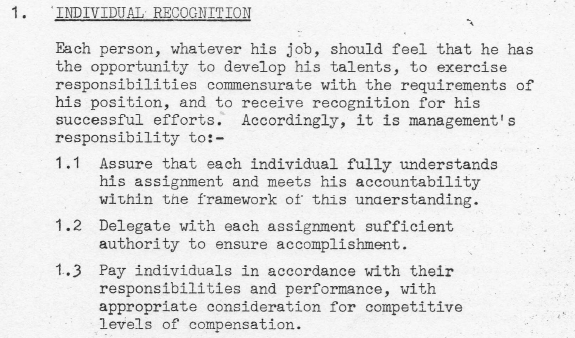 … and there in the first paragraph are the three reasons K is leaving.
She doesn’t feel that she is being given the opportunity to develop her talents. She regularly experiences her responsibilities being exercised by someone higher up the organigram who has decided they do not need to consult before taking action unilaterally. Successful efforts are often just considered ‘part of the job’.
So how does my 1968 corporation suggest K’s employer avoid losing more good people? There are a total of eight points in section one but in this post I want to look at just the first three.
It is management’s responsibility first to “assure that each individual fully understands his assignment and meets his accountability with the framework of this understanding“. Then they (management) should “delegate with each assignment sufficient authority to ensure accomplishment.”
K’s organisation is not the only one I see that regularly fails in this regard. Assure means ‘to make certain something happens’ and when you add that to each person fully understanding their particular assignment you deliver a significant challenge to the leadership of any organisation.
I think that many leadership teams believe they are very good at assuring that the people who report to them (the managers) fully understand their assignments when they use words like:
“You are responsible for delivering the following change in this organisational indicator … a 10% decrease in injuries, a 10% increase in availability, a 10% decrease in costs, a 10% increase in sales, or a 10% decrease in the number of non-compliances.”
A budget is set, authority is given and a team of direct reports is provided to create that change.
Where I think that many leadership teams fail is in assuring that each person in that team of direct reports receives what they need – remember the responsibility is to each person in the organisation. In K’s case it is clear that the person she reports to chooses not to acknowledge the specialist nature of K’s role and may delegate assignments but retains authority. To my mind that adds up to a failure to meet their accountability as a manager.
K is pretty clear about who is responsible but I think you need to look a little further for the cause of that failure.
Upwards.
I have lost count of the number of times I have met people who have been promoted into roles they are not ready for. Most often it is described as a ‘developmental role’, something that will allow the person to ‘develop the skills they need to be successful in the role…’
Stop right there. I’m sorry? You are putting someone you recognise as lacking a particular set of skills into a role that requires them to have those skills to succeed? It is the Sink-or-Swim school of management that sees a drowning employee dragged from one pool only to be thrown into another where they will continue to thrash about and drag yet more people down as they struggle to keep their heads above water.
In contrast, for my 1968 corporation the focus is on developing talents, things we have already displayed an aptitude for.
Organisational leadership regularly fails employees like both K and her manager. Both suffer as a result and neither are able to make the contribution they are capable of towards organisational goals. It is a lose-lose-lose situation in the short-term that quickly results in the organisation losing one or more of the means by which it accomplishes its purpose – their employees!
Why is it then that leadership teams are surprised then when good people start looking for roles in other organisations?
In Part 2 I touched on the third piece of recognition – that ‘competitive levels of compensation’ are necessary but will only go so far. When it is not there people notice, but when it is there the employee sees it as ‘just part of the job’. Section 1.3 now adds another dimension:”in accordance with their responsibilities and performance“. Given managers bear most of the responsibility for delivering recognition to the individuals who work for them, how many organisations do you know where the manager’s compensation is linked to their performance in retaining staff; where their bonus was linked not to the performance of the corporation but to how well they develop and recognise the capabilities of their team?
I wonder how quickly organisational cultures would change if they were?
***
This is the 3rd in my looking backwards to find a way forward series examining what corporations have forgotten in the last 50 years. The earlier piece can be read here.
If you enjoyed reading this or my other posts you can subscribe and receive them via email simply by putting your email address into the Email Subscription box just on the right of the web page. You will receive a confirmation email (which some systems will think is spam so keep an eye on your junk mail) that you need to acknowledge to complete the subscription process.
can we just forget I mentioned it?
In my post of January 25 this year, how understanding my values removed the need to get motivated to do anything…, I seem to have been pretty pleased with myself. I thought I had cracked it. I shared one of my goals:
“… to continue my practice of Aikido and develop my understanding of the Art to a black belt level and beyond.”
I went on to talk about how easy it was to get out and get the exercise that I thought I needed to move towards that goal. The last few weeks has prompted me to revisit that post and ask you for a favour.
Can we just forget I mentioned it?
What got me started down this path was a short TED presentation by Derek Sivers who says it’s better to keep your goals secret. He shows evidence that people who talk about their ambitions are less likely to achieve them – and I am more than a little concerned that I might be a case study in support of his argument. In a neat twist on the “your brain can’t tell the difference between you shooting baskets and you visualising you shooting baskets”, he suggests that telling people about your goals gets your brain thinking you have already achieved them. The result is a reduction in drive to work towards achieving the goal.
I have heard the counter argument that you should tell everybody about your goals because that creates people who will hold you accountable for achieving them. But what about when you have told a large number of people what you are planning to do and then you don’t? Does that get you the worst of both worlds?
Despite my January declarations I have hardly been on the mat at Aikido since. I have however been a regular at Pilates sessions since then and in the last month or two have added extra sessions at home. I have started lessons with a teacher of the Alexander technique. I have made some fairly significant changes to my diet.
I have lost weight and gained strength.
My posture has improved.
I am more aware of how I use and miss-use my body.
But I haven’t been to an AIkido class for months.
There are days when I think I am making progress and there are others when the new twinges in my back strike to remind me of the reason why I am not on the mat at the moment. On those days (and today is one of them) I start to wonder why I even bother.
My reframing Leadership workshops are another example. A lot of people know about my goals for bringing the Samurai Game to Australia. I have tried a couple of different ways to light in others the spark that the Samurai Game has lit in me but to no avail. When you have mailed out thousands of flyers, run google ads promoting the website and talked to anyone who will listen, it is difficult to face up to people each day who ask “How is it all going with your workshops?“, knowing that you have to say “well … it isn’t.”
It starts to get you down.
I don’t really know what I am going to do next, or even if I am going to do anything at all. For now let’s just pretend that I never mentioned it and we can treat it like a poorly organised surprise party – you can act like you knew nothing about it but admit to your friends later that the invitation that was mistakenly posted to you gave it away. If you need me I will be hiding behind the lounge chair hoping you will still show up …
… until some of the wonderful teachers in my life show me there is another way to look at things.
My Alexander Technique teacher who can’t hide her pleasure when I tell her of the new pains I am feeling. They are a tangible sign of change, of growth. She reminds me that you cannot hope for change and expect everything to stay the same.
My Aikido Sensei who shared a story that reminded me that some of the sweetest moments in your life occur when you are hanging by a thread, the past threatening to consume you while you look towards a future with big sharp pointy teeth – if only you have the presence of mine that allows you to see those moments are always there for you to enjoy.
My friend who made me smile because of the way she smiled as she proved the other two right and shared a story of how her frustrations and failures around a changing relationship with her daughter created a space into which they were both able to grow.
I don’t know about you but I think they are things worth mentioning and worth remembering!
why can’t we see the signs?
I recently participated in a Positive Communities Forum that looked at the concept of eco-retrofitting of commercial and residential buildings.
I was part of a group that was looking at issues from the perspective of biodiversity loss and much of what we talked about seemed to centre around communicating to people the importance and value of biodiversity. Efforts in recent years to reduce Brisbane’s water consumption in response to the drought was cited as a successful program in changing people’s behaviour and one that might be applied to biodiversity.
There wasn’t enough time to talk about the fact that it required things to get to the point where the whole of Brisbane was facing the very real and immanent prospect of no drinking water for the Government and the wider population to sit up and take notice. The signs had been there for years but we couldn’t see them.
Our over-consumption of biodiversity is another one of those situations. People will say that it is all too big, too hard to get our head around. A recent story on the decline of northern Australian ecosystems includes this quote from Professor John Woinarski:
“It’s perplexing. Much of the landscape still looks extraordinarily intact and natural and extensive and beautiful, but some of the species are clearly falling out of that landscape. It’s been a difficult task for us to figure out what’s causing that decline, given the apparent naturalness of landscape.”
We can’t actually see the signs around us yet so how can we be expected to take notice of them?
Until recently I would have said people choose to ignore the signs that are clearly there. But a couple of recent events have got me thinking that is not the case and that the problems we face in sharing our message with others (whatever your message might be) are a lot bigger than that…
Keeping people safe in manufacturing environments is an ongoing challenge. A friend told me recently of a multinational who kicked off a week-long safety initiative with a town hall style meeting for everyone working in the organisation. Attendance was pretty much mandatory so to accommodate the larger than usual numbers who would attend an area was set aside in the warehouse.
By all reports the meeting went very well. At the end one employee took the microphone and asked a simple question.
“In coming to this meeting, who came into the warehouse through the boom-gates?”
A large number of people indicated they had – they had come from other buildings and it was the obvious and shortest route to the meeting.
“Who saw the ‘pedestrian access prohibited’ signs?”
A significant proportion said they had. A large number had not. Either way it represents a significant challenge to those who are given the job of helping people to stay safe. I suppose a large number had seen the signs and decided to ignore them because it was just easier.
But what about those who said they hadn’t seen the signs? Really? They had to walk right past them. Surely they had seen them …
Because I had another appointment on the other side of town after the Positive Communities Forum I drove and parked in the city. I parked and gave my early-bird extra discount voucher to the attendant who gave me a $6 discount card in return and told me I should use it after I inserted my validated ticket at the pay station. “This afternoon when I leave?“, “Yep, use the discount one when you pay.” Off I went to my forum making a note of the location of the pay station I passed on the way.
Early bird rates only apply if you stay until after 3 pm and as I was back in the car park a little early I put my bag in the car and followed my morning route to the pay station to wait for 3 pm to tick over.
On the way I noticed five different signs all informing me that to take advantage of early-bird rates I need to validate my ticket immediately – before leaving the car park. Five! The attendant told me to do it and I walked past five signs on my way out that morning and I still didn’t see them.
My failure to see the signs tripled the cost of my parking that day. For the employees at the safety meeting the cost was a small measure of public embarrassment. A small price given the obvious lack of attention.
In the Samurai Game a lack of attention can cost you your (metaphorical) life. At home, at work, in relationships, in life in general a lack of attention can cost us our lives, or worse, the life of someone we love.
In Aldus Huxley’s book Island there are birds that have been trained to call “Attention. Attention.”
I hope that this post will do the same and help you to avoid the pain (thanks Little Brother) that will come unless you:
… pay attention;
… look for the signs;
… take action to keep yourself and the ones you love safe.
At the very least you will avoid the pain of missing out on the early bird parking rates.
***
If you enjoyed reading this or my other posts you can subscribe and receive them via email simply by putting your email address into the Email Subscription box just up on the right. You will receive a confirmation email (which some systems will think is spam so keep an eye on your junk mail) that you need to acknowledge to complete the subscription process.
sometimes it is just easier not to…
This blogging is a strange business.
Last week I found myself sitting in a coffee shop with 20 minutes spare. I took out my notebook and scribbled down a page and a half of thoughts under the heading “sometimes it is just easier not to…”
It started … Today is one of those days. One of those days when you find yourself asking “Why?” and then discovering that the question might more appropriately by phrased as “How?”
It shouldn’t be surprising to find that I often write about subjects that are currently occupying my mind and that if you had had the chance to chat with me over coffee I probably would have raised the topic in conversation. Sometimes it is talking to people that crystalises the ideas.

That seems to have been the case with my last post Organic Tobacco. I visited my brother the day before I wrote that post and we talked over coffee. After I published the post he emailed me and pointed out that he saw a lot of the “its not my job …” in what I had talked about with him and finished with some gentle encouragement to step up and stop choosing organic tobacco all the time.
What I thought about saying in my response was that there is a difference between choosing-believing that because it says organic it must be good for you and choosing-knowing that whatever adjective you use it is still tobacco and that ain’t good for you.
I am not sure I believe my own argument. It is different, but not by much.
The reality is that sometimes we do pick organic tobacco, we make choices that seem to lead us to less than optimal outcomes. That is where you start asking why. Why don’t we always choose the path that leads most directly towards the outcome we want? I think the answer is that sometimes it is just easier not to. Steven Pressfield in his great book The War of Art: Break Through the Blocks and Win Your Inner Creative Battles
What I did write in response to my brother’s musings was this:
I know I am 100% responsible for the situations I find myself in each day. I also know that I am reaping today a harvest that was first sown many years ago. So in that respect I planted the seed and there is no use complaining that you wanted oranges when you planted lemon seeds. The best you can do is learn from the past and make sure what ever you plant today is going to grow into what you want in your future – and try to make lemonade.
Like organic tobacco that is true. And it is untrue. If we know the why, then it must be time to turn the question around and ask how.
Megan posted a great response to Organic Tobacco and ended her comments with:
“My point? I want to influence but am afraid to offend… But subtlety just is just not cutting it! I take my mother’s words to heart – that to not speak out about the wrongs in the world, is to agree with them.”
Megan (and her mother) are right of course. But sometimes it is just easier not to … and that might just be what it is that makes it ‘one of those days’.
organic tobacco …
I was watching an old Seth Godin talk on TED this week about things in our societies that are broken. One phrase stuck in my mind – “organic tobacco”. A phrase that, while it might be the truth, is also a lie. It annoys me that we as a population cannot be trusted to see behind the truth to the lie that lurks beneath, so the producers are required to add this warning to their packaging:
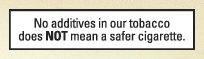
Philip Adams has explored just what people are allowed to call “fresh” in an episode of Late Night Live and it has very little to do with the characteristics you would expect fresh food to have. Then there is all the talk about “fresh orange juice” containing juice that is over twelve months old. People who use the word fresh in questionable circumstances are counting on the fact that we will not question the truth of the word.
More recently I read Sweet Poison: Why Sugar is Making Us Fat
100% natural
no artificial sweeteners
natural alternative to cane sugar
All of a sudden the warning on organic tobacco doesn’t seem so stupid.
It is clear that something is broken. Seth Godin guessed at a couple of reasons why so many things are broken:
not my job
selfish jerks
I didn’t know
the world changed
broken on purpose
A lot of the time I think you can put it down to ‘ the world has changed’. For a while there I will accept that you could argue ‘I didn’t know’ about tobacco. As that position is no longer defensible you move into the realm of selfish jerks who keep things broken on purpose to protect their own interests. David Gillespie will tell you that about sugar (sucrose) and Norman Doidge will tell you that about the way we have been told to view our own brains for the last few centuries.
The first one on the list is the one I find hardest to deal with because it is the one that seeks to absolve me of my personal responsibility:
I know it is broken but … it is not my job to fix it.
Or the more subtle version:
I know it is broken but … I haven’t been given the power to do anything about it.
Both true. Both lies. Beneath them lurks something which is for me a little closer to the bone:
I know it is broken but … I am afraid.
That might be the truth. But that still doesn’t explain why most of us actively choose not to do anything about it. We seem content to continue buying our own manifestation of organic tobacco.
***
If you enjoyed reading this or my other posts you can subscribe and receive them via email simply by putting your email address into the Email Subscription box just up on the right. You will receive a confirmation email (which some systems will think is spam so keep an eye on your junk mail) that you need to acknowledge to complete the subscription process.


 finding my own Way