are you even capable of being quiet?
“Music is the space between the notes.”
– Claude Debussy
I have been known to talk. A lot.
It is how I get things straight. I say the words out loud and when I hear them set free from the inside of my head I get to hear just how silly they might sound. Or not.
I have been blessed with friends who get their things straight in silence. (Apparently you don’t need to vocalise every thought!) I guess they need the quiet so they can hear the words inside their head to get a feel for how silly they might sound out loud. Or not.
I don’t know. I mean, I know there are people like that. I am aware of their existence.
I just don’t understand them. Or their silences.
I would like to think that I am getting better at talking less and listening more. I don’t know. I guess I am. Or not.
What I do know that is takes both the notes and the spaces between them to make the music.
i don’t want to say I told you so, but …
… there is a great deal of wisdom that you don’t hear coming from your friends.
This last weekend I signed up and paid my money for a two-day workshop – the Australian Professional Speakers Academy – delivered by some of the leading professional speakers in Australia. We spent the afternoon of the first day under the guidance of a wonderful speaker by the name of Karen Schmidt who is all about growing engaging leaders. She told a story about Ian Berry, a colleague of hers who was looking for feedback from a more experienced speaker on some new content he had developed.
After about ten minutes or so the comment was made that you could see a number of places where Ian had displayed characteristics of many of the leading speakers of the day. A broad smile spread across Ian’s face.
“The problem is, I didn’t see much of Ian Berry ….”
The lesson? Be you!
Because that is what you do best and that is the one thing that nobody else will ever be able to do as well as you. That is when you will light up and that is when your audience will engage the most with you.
It made perfect sense! This sort of insight is what I paid the money for. That is worth the price of admission right there. That is what I need to focus on.
Now if I can only figure out where I have heard that before…
“I just didn’t feel like I was seeing the real you up there. I mean that stuff was interesting but when you started talking about your time as a guide at the art gallery … you just lit up. That was when I saw the Paul I know. That was when I was engaged, when you really grabbed my attention. You should do more of that sort of stuff.”
That insight into me was offered by a close friend a few years back after he had attended the very first Samurai Game that I led.
At the time I nodded and thanked him but I really didn’t pay much attention to his comments. It was new content that I was trying out for the first time so it wasn’t surprising that it was a bit rough. But then so was the stuff about the art gallery… I don’t know why I even asked for his feedback if I wasn’t prepared to listen to him.
It’s not that our friends are not wise. It’s that we often don’t hear their wisdom.
They will tell us the truth even if we are not ready to hear what they have to say. That is why we call them our friends.
***
If you enjoyed reading this or my other posts you can subscribe and receive them via email simply by putting your email address into the Email Subscription box just on the right of my blog home page. You will receive a confirmation email (which some systems will think is spam so keep an eye on your junk mail) that you need to acknowledge to complete the subscription process.
you have no idea what you are doing do you?
Imagining them naked isn’t going to get you through it this time either!
I know that you are always looking over your shoulder waiting for somebody to get wise to that fact that you are a fraud and you don’t really know what you are doing. Waiting for someone to shout “You have no idea!”
But you don’t have to worry. Your secret is safe with me.
Why? Because I feel the same way.
All the time.
Edward Norton feels that way every time he starts something new and he has acted professionally for 20 years! 
And if the people you work with and work for were really honest they would tell you they feel the same way.
All the time.
That is OK. That feeling is never going to go away. Get comfortable with it and do it anyway.
The catch is that once in a while you are right. You really don’t have any idea and whatever it is you are doing IS going to fail.
That is OK too. Do it anyway because the thing you learn from the failure will be the key to your future success.
So the next time you walk into that room to present your vision to the world thinking that this will be the day that everyone else figures you out … don’t bother using that old trick of imagining everyone else is naked to try to calm your nerves – just remember they all feel the same way you do.
All the time.
They are worried you will figure out they have no idea and, because the best defense is a good offense, it is the reason why they will challenge you and try to call your vision into question. Be gentle with them. They are afraid and you have nothing to worry about.
Your secret is safe with me.
***
If you enjoyed reading this or my other posts you can subscribe and receive them via email simply by putting your email address into the Email Subscription box just on the right of my blog home page. You will receive a confirmation email (which some systems will think is spam so keep an eye on your junk mail) that you need to acknowledge to complete the subscription process.
fighting for Queen and Country
From the throats of those who watch comes a sound that gives voice to the words that you are not ready to hear, for they know something that you only suspect. Something that you are not willing to admit to yourself let alone to others.
For Queen and Country!
 You don’t hear words like that very often these days. I think we should. There is something about battle that draws out the best in a person.
Of course you don’t have to be fighting for your Queen or King or President – when there is enough “at stake” just going into battle for your local football team is enough.
There is something significant, something primal, about striding out onto the field battle on behalf of a crowd of people who are supporting you, who want to see you win.
They want you to give your all, to give 110%. For they know that when you think you have given everything you have to the cause … there is always something more that you can give.
For the spectator though it is easy. The spectator is just one safe in the crowd. For them it is ‘us against them’ without the risk. Our team against theirs without the need to train. “WE won! We WON!” they cry as they walk away from the battlefield invested only in the colours of those who fought on their behalf.
They share in the victory having invested very little of themselves in the game.
For those who are on the field, the experience is a very different one.
An individual experience. You stand alone and ultimately, while you might be surrounded by your team, you are fighting alone for something that you have personally invested in. For Queen or Country. For State or Team.
I think what makes the difference is the magnitude of your vision. It depends on what is at stake.
During the Samurai Game we invite you to play the game as if your very life depended on it. If you cannot invest in that vision you might need to play for something bigger – to play as if the life of someone you love depended on it.
That is a lot to have at stake.
It is a vision of something greater than yourself and that is the key.
When the stakes are high enough you discover that the crowd is right. When you think you have given everything you have to the cause … there is always something more that you can give.
What are you going into battle for? What is your vision for your life?
Is it of something greater than yourself? Or are you just watching – a face in the crowd?
***
If you enjoyed reading this or my other posts you can subscribe and receive them via email simply by putting your email address into the Email Subscription box just on the right of my blog home page. You will receive a confirmation email (which some systems will think is spam so keep an eye on your junk mail) that you need to acknowledge to complete the subscription process.
Proven 2000% return! That is what Google would do.
That is what the man said. (Not the bit about Google though – I added that)
Actually the figure he quoted was in excess of 2000% return but I didn’t want to be too sensationalist.
Almost three-dozen mid-level managers participated in the pilot program and the data that was collected demonstrated the value that had been delivered to the organisation. I suspect that the figure would have been much, much higher if you took into account the benefits that flowed to the individuals who participated.
The data is there. The return has been proven. Nobody wants to listen.
They say that they assumed he just made the numbers up. They say they already have programs in place that have been running for a number of years – but when pushed they say they have no idea how effective they are. They don’t have the data but everyone else has similar programs so that is enough for now.
Organisations who say they want to be a leader in their market are not interested because the pilot was conducted in a different sector. “It sounds very interesting but …” they say they would like to wait and see how it works in an organisation similar to theirs.
Last time I checked that makes you a follower not a leader.
I am not talking about a get-rich-quick scheme or a new piece of whizzy software or super fast hardware. This is a program that goes to the very heart of the success of any business – the health and productivity of their people.
After spending an hour or two with a person you get a pretty good idea of whether they are telling the truth or whether they are full of … spin. Dr Paul Lanthois is genuine and is all about delivering sustainable and long-term improvements in the health and the productivity of the people he works with. He has seen the clouds from both sides now and he has done his research.
His workforce sustainability and productivity programs have demonstrated their value. He has the results to prove it. Why isn’t that enough?
His story made me wonder why it is that as individuals and as organisations we continue to do things when we have no clear understanding of the benefits (or otherwise) that flow from them? What is it that keeps us tied to particular behaviours when there is compelling evidence that we could (and would) benefit from a change, from adopting a different approach?
As a parent I find myself saying…“Just because your sister did it doesn’t mean that you should!”
Workplace programs can be a bit like that … “But this is what Google did! We should do that too.”
(I know they would like us to think it was the case, but I am pretty sure Google hasn’t found all the answers. Yet.)
If you really want to be a leader in your field don’t do what everyone else has done. You don’t want to do what Google has done – do what Google would do.
Figure out a way to measure the benefits and give that new program or initiative a try. Then let everyone else follow your lead.
***
If you enjoyed reading this or my other posts you can subscribe and receive them via email simply by putting your email address into the Email Subscription box just on the right of my blog home page. You will receive a confirmation email (which some systems will think is spam so keep an eye on your junk mail) that you need to acknowledge to complete the subscription process.
spend a day living in the mirror
Habits are powerful. We come to depend on them. They free our mind from the detail of the immediate task in front of us and allow us to focus on other things.
When activities become habitual we don’t have to think about them as we are doing them. Driving a car, typing, getting dressed all become habits.
Signing your own name, using the mouse, brushing your teeth, swiping your access card to get into work, brushing your hair – all things that we do mostly without thinking about them. In fact we mostly do them while we are thinking about something else.
The kids, the dog, the call we need to return, the report that has to be completed by 10 am.
Habits are dangerous. We come to depend on them. They set our mind adrift and prevent us from seeing the detail of what is right in front of us.
In the worst cases habits can get us killed.
Try spending a day living in the mirror. Or even just an hour.
Brush you hair with the other hand. Wear your proximity card on the left instead of the right, put your wallet in the right pocket instead of the left and put your mouse on the other side of your keyboard. Drink your coffee without sugar.
Notice how such small changes make a huge difference in the level of awareness that you bring to the task. Then go back to doing it the habitual way and notice how disconnected you are from your body in comparison.
Notice the things that you don’t notice.
What do we miss as we go through each day dependent on our habits?
What details do we miss in those relationships that have become habituated?
What opportunities do we miss when our responses to life are habitual?
Spend a day living in the mirror and I know you will be amazed at what you see.
don’t do it the first time for real
I was at a seminar recently that examined how organisations responded to the risks that materialised as a result of the recent floods in Brisbane. It concluded with a slide headed “Take home messages.” Along with Take the time now to review what worked and what didn’t and Do not fail to plan was this statement:
Don’t do it the first time for real!
Many organisations have plans in place to deal with emergency situations, natural disasters and other types of business interruptions. Not so many organisation actually practice their plans. Apparently only a handful then think outside the parameters of the plans as they are written to wonder “What if …?” or ask someone outside the organisation to assess their performance, provide feedback and facilitate reflection.
Practice is important because when you are actually in it, doing it under pressure, you get to see first hand the quality of the decisions you make. You can see how you and other people on your team behave under pressure and find out what you will actually do when there are only two of you left and there are seven things that need to be done – now!
Reflecting on how you behaved after the event, wondering “What if…?” and inviting feedback helps you find out what is really important.
That kind of experience gives you the gift of seeing into the future and being able to come back and do things differently.
I think Ric Elias would agree. You probably don’t know Ric but you might have heard about Flight 1549, the plane that crash-landed in the Hudson River in New York in January 2009? Ric had a seat in the front row. His five-minute TED talk 3 things I learned while my plane crashed is a compelling take on the same theme. Your life can change in an instant.
That kind of experience gives you the gift of seeing into the future and being able to come back and do things differently.
I think that is one of the opportunities that The Samurai Game offers to people – minus the plane crash of course! It gives you the opportunity to practice, of doing it under pressure. Then you get the chance to reflect with others who have shared the experience with you. What the majority of people are surprised to discover is that they have completely different perceptions of what actually happened.
If you are a leader in an organisation you want your people practicing their ethical decision-making before they have to do it for real. Case studies, like the documents that set out your emergency plan, are important but they don’t give you the benefit that comes with actual practice. Sharing “what I would do in that situation” is one thing, discussing and reflecting on”what I did in that situation” is another thing altogether.
If you are coaching people to improve their communication or leadership style it is often useful to say “not everyone sees the situation the same way that you do”. It is a much more powerful learning to experience the subjective nature of our shared reality first hand.
That kind of experience gives you the gift of seeing into the future and being able to come back and do things differently.
Whatever it is – practice it. Emergency response plans, ethical decision-making, data recovery from back-ups or even CPR. Practice. Today.
You don’t want to do any of them the first time for real.
***
If you enjoyed reading this or my other posts you can subscribe and receive them via email simply by putting your email address into the Email Subscription box just on the right of my blog home page. You will receive a confirmation email (which some systems will think is spam so keep an eye on your junk mail) that you need to acknowledge to complete the subscription process.
This is the 4th in my looking backwards series examining what corporations have forgotten in the last 50 years. It is based on a document from 1968 entitled GUIDING PRINCIPLES AND OBJECTIVES IN EMPLOYEE RELATIONS. The earlier piece which started exploring the subject of individual recognition can be read here.
They say that you have to give in order to receive and the next two points cover the areas of giving credit and criticism this way:

My first instinct is to say there is not much more I can say in regards to applying these in the corporate world. They just make sense.
Give prompt and generous credit when credit is due. Period. Give private, tempered guidance or criticism. Simple.
Generous and in a manner that will help the individual … is where I think people come unstuck.
Take a moment to think about a person you work with or someone who reports to you. Do you know what they value most?
Family? Money? Increased influence? Increased responsibility? Leisure time? A good single origin coffee? Respect of their peers? What do I value?
If you can’t answer that question then you can be as prompt as you like but there is a good chance you will never hit the mark as far as being generous goes. To be clear, I don’t think my 1968 Corporation meant that generous equals huge amounts of time and/or money.
My dictionary defines generous as:
showing a readiness to give more of something than is strictly necessary or expected.
And there is your opportunity. You can recognise someone for the contribution they have made by giving them a movie voucher at the monthly team meeting. That is the sort of thing they might expect. Giving an end of year hamper is a nice way to recognise good performance. Until it becomes expected. The challenge there for a leader is, I think, to do the unexpected.
Understand what people value most and give them that in order to deliver real value to your organisation.
If I value money highly, then sure give me a bonus. The respect of my peers – give me praise for my specific contribution to the team’s success. Leisure time – give me the afternoon off. Family – tell me to come in around 11 am tomorrow so that I can drop the kids at school with my partner and go for coffee or help with the grocery shopping.
Giving me extra work to do sounds more like a punishment than a reward – unless you understand that what I value most is increased responsibility and the opportunity to prove to you what I am really capable of. Or as Dan Pink suggests maybe you pay me to do something I love doing that is not work related.
The value that the Corporation receives from giving me what I value is immense.
On the criticism side I think the approach should be the same. Take the time to understand what works best for me. Anyone who has managed to stay married will tell you there is a right way and a wrong way to go about facilitating behaviour change.
Looking for opportunities to “catch them doing it right” means that you can reinforce the behaviours you want. Checking in to make sure you share a common understanding of what is expected. An informal discussion over coffee, a formal review of progress against the current set of KPIs or an After Action Review to figure out what worked and what did not. A performance management program facilitated by someone in HR…
The focus must be on understanding what is going to work best for the individual concerned so that you can give the guidance or criticism in a manner that best helps the individual to learn from their mistakes.
Understand what people value most and use that knowledge to deliver value when you give both credit and criticism. You will be showing a readiness to give more of something than is strictly necessary or expected. You will be surprised by what you receive.
***
This is the 4th in my occasional series looking backwards to find a way forward series examining what corporations have forgotten in the last 50 years. The first piece in the series can be read here.
If you enjoyed reading this or my other posts you can subscribe and receive them via email simply by putting your email address into the Email Subscription box just on the right of my blog home page. You will receive a confirmation email (which some systems will think is spam so keep an eye on your junk mail) that you need to acknowledge to complete the subscription process.
why the show MUST go on
Art imitates life. If you have never experienced an “opening night” in the theatre you should.
I don’t mean experience it as an audience member but as a member of the production.
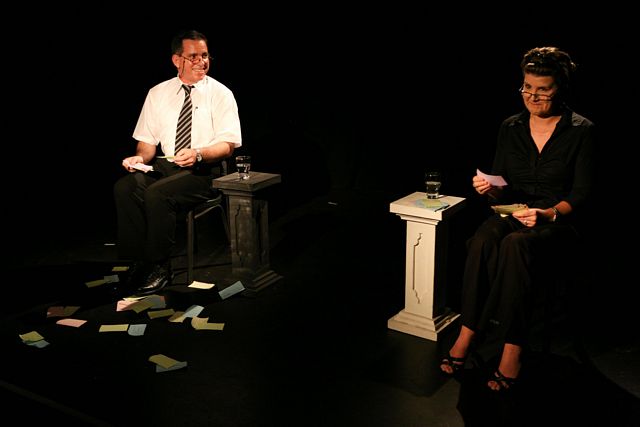
Two lives told in post-it notes
My first serious steps onto the stage were made one summer in the early 90’s when I managed to secure the role of a teddy bear (complete with full bear suit, face paint and an outrageous French accent).
Before then I was a theatre boyfriend who sat in the lighting box.
Since then I have had experience as a volunteer in all parts of the life of a local hundred seat theatre – on stage as an actor, back stage constructing sets and also as Stage Manager, in the sound and lighting box, programme designer, audience member, member of the Management Committee and Director of a couple of one-act plays and a full length show.
I couldn’t tell you the number of times over the years that I have heard (or used) the phrase “The show must go on!” I do know that in all those years I never asked “Why?”
A couple of recent blog posts have got me thinking about it though.
Rachel Hill’s recent post in Musings of an Inappropriate Woman alerted me to a new book out from Tina Fey (of Saturday Night Live fame) called Bossypants. The subheading is this:
The show doesn’t go on because it’s ready; it goes on because it’s 11:30
On the same day Kelly Diels posted Not ready but willing in which these first words grabbed me by the front of the shirt and shook me:
We’re never really ready.
I’m not ready to apologize. I’m not ready for a relationship. I’m not ready for marriage. We’re not ready to have kids. I’m not ready to apply to that program/school/job/life. I’m not ready to face the truth. I’m not ready for cancer. I’m not ready to leave.
I’m not ready for this.
Looking back over my years in the theatre I realised that there was not a single occasion where I felt that a production was ready to go on. We always managed to get things to the point where it could go on, where we (hopefully) wouldn’t be too embarrassed presenting the work to a paying public.
But it never really felt “ready”.
But when the clock ticks around towards 7:30 pm on opening night the show must go on … and so it did.
Some nights despite our lack of feeling ready the magic was there and people laughed or cried or both because of the work we did. Some nights towards the end of a run when we felt like we were ready – we fell flat.
Closing night comes around all too soon. The night you know will be your last opportunity to do this thing, to do it right or at least to do it well. It is almost always one of the best because we always give our best.
But then you discover you are not ready … for it to finish.
In ‘real life’ we are trying to help our youngest daughter to understand that it doesn’t have to be perfect. That you can make mistakes. That it is OK to fail. That it is more than just OK to be wrong.
While I am helping her I need to follow my own advice and remember what I learnt in the theatre.
You can’t spend your life waiting until you are ready.
The show goes on because the show MUST go on – ready or not. Life goes on – because life goes on whether we are ready or we are not.
You never really feel ready and if you aren’t feeling a certain amount of terror while you are waiting for the curtain to open then I believe you are not going to bring your best. (Steven Pressfield reminds us in his new book Do the Work, that at age 75 Henry Fonda still threw-up before just about every stage performance!)
Actors, Stage Manager and Crew, Lighting and Sound, Front of House they all have mortgages to pay, sick kids, sick parents, bosses who don’t understand them, subordinates who don’t listen to them, a car that needs repair and telemarketers to deal with – just the same as you do.
It doesn’t stop them from doing their thing. It shouldn’t stop you.
Saying to yourself “I am not ready to do that!” might be the truth. But that still doesn’t explain why most of us actively choose not to do anything about it.
You never know when your closing night is going to be so don’t wait until you feel ready. The show must go on. Now.
Remember, life imitates art … the one thing I can guarantee you will not be ready for, is for it to finish.
***
Photography by Kayleen Gibson, Kaymar Kreations. Used with permission. If you enjoyed reading this or my other posts you can subscribe and receive them via email simply by putting your email address into the Email Subscription box just on the right of my blog home page. You will receive a confirmation email (which some systems will think is spam so keep an eye on your junk mail) that you need to acknowledge to complete the subscription process.
mental health days
I can’t remember who first introduced me to that phrase but I know that I am grateful to them.
Over the last ten years I have taken a couple of mental health days. Nothing physically wrong with me – no flu, no cough or headache – nothing that would get me a doctor’s certificate or make me sound unbelievably ‘sick’ on the phone. But that is the idea.
Take the day off before the fog in my head manifests as a dis-ease in my body. Or before the fog in my head becomes the norm rather than the exception.
So no post last week and if you had read my previous post on change and the weather that probably wasn’t a surprise. It has been a very busy couple of weeks. On top of all the usual stuff that makes life busy I added some extra travel and a few unexpected business related surprises (including the news that the best bookkeeper in the world – our bookkeeper – was taking a full-time role and so would not be our bookkeeper any more!)
So I took a day off from the blog. I took a mental health day. Being self-employed has its upsides and its downsides. One upside is that I get a much greater say in when and how long I work. So I acknowledge it is easier for me to take some time to get my head right, but I want to recommend mental health days to you and to your boss. I think they are more important and probably more beneficial than the traditional ‘sick days’. (A rant on sick people who come to work to share their disease instead of staying at home can wait for another time.)
In the past month or so I have spoken to a lot of people who are working hard just trying to keep their head above water. Their boss, their employees, their kids, their parents, their husband, their wife, their ex … you know what it is like.
What has been more unsettling is the handful of people I have spoken with who have sunk below the water and told me that at the time the will to live had left them. They have brought their heads above water again but the experience has left its mark. On them and now through their stories on me.
The beyondblue website here in Australia states:
Depression is currently the highest medical cause of disability worldwide and predicted to be the second highest medical cause of death and disability worldwide by 2020.
Don’t let it get to that. You might be surprised to hear that if you stop running the world will not stop turning. Sit in the park in the sunshine during your lunch break and watch the world go by. Have tea with a friend or just get out and go somewhere nice for coffee all by yourself.
Take a mental health day or just a mental health hour. You’ll feel better for it.
I know I did.
***
If you enjoyed reading this or my other posts you can subscribe and receive them via email simply by putting your email address into the Email Subscription box just on the right of my blog home page. You will receive a confirmation email (which some systems will think is spam so keep an eye on your junk mail) that you need to acknowledge to complete the subscription process.


 finding my own Way